


Managing compensation architectures within private equity and venture capital requires absolute mathematical precision. Among these various mechanisms, carried interest stands out as the primary engine for aligning GP and LP performance incentives.
However, many investment firms continue to track these high stakes allocations through legacy tools. Relying on manual formulas introduces operational bottlenecks and increases risk exposure for financial firms during critical distribution events.
To protect firm margins and retain top dealmakers, fund managers need to modernize their tracking foundations.
What Is Carry and How Is It Tracked?
Carried interest represents the share of profits that general partners receive from an investment fund, typically set at a baseline of 20 percent.
To execute this payouts properly, modern investment firms utilize specialized carried interest management software to run automated waterfall models, distribute participant splits, and secure historical audit logs.
Without institutional tracking software, scaling a multi-fund strategy creates immense operational friction.
Fund operations teams must manually track vesting schedules, adjust for partner departures, and cross-reference multiple co-investment vehicles simultaneously:
| Operational Task | Legacy Spreadsheet Approach | Centralized Software Approach |
|---|---|---|
| Waterfall Modeling | Manual cell linking with high risk of broken circular references. | Programmatic execution based on institutional legal parameters. |
| Vesting Management | Static calendar tracking vulnerable to manual oversight errors. | Real time automated triggers mapped to participant lifecycle stages. |
| Participant Portals | Fragmented email updates containing PDF point in time statements. | On demand secure login access showcasing real time value models. |
The Core Mechanics of a Carried Interest Calculation
Calculating profits requires navigating a strict hierarchy of distribution rules.
Before any general partner can access incentive distributions, the fund must satisfy its obligations to its limited partners.
This sequence is commonly governed by an institutional four-tier framework:
- Return of Capital: 100 percent of cash distributions flow to LPs until their initial drawn capital is fully recovered.
- The Preferred Return: LPs receive 100 percent of subsequent distributions until they hit their hurdle rate, which is typically set at 8 percent compounded annually.
- The GP Catch Up: Profits pivot to the general partner until they receive their designated percentage of all distributed returns up to that point.
- The Final Split: All remaining capital distributions are split according to the standard 80/20 ratio.
To model this distribution path accurately, teams need software that can dynamically calculate these shifts without requiring custom formulas.
For a deeper analysis of how complex incentive structures apply across broader executive contexts, view our comprehensive guide to long-term incentive plans.
Why General Partners Are Transitioning to Automated Tracking Tools
The administrative pressure on alternative asset managers has escalated significantly.
LPs expect institutional grade reporting frameworks that prove exact alignment with fund terms.
According to standard industry guidance from bodies like the Institutional Limited Partners Association, transparent fee and allocation models are critical for maintaining long-term investor trust.
Automated carried interest tools solve these structural expectations by providing key internal advantages:
- Absolute Audit Trails: Every calculation step and adjustment is recorded, eliminating friction during regulatory reviews.
- Bespoke Split Capabilities: Managing participant pools with unique individual vesting cliffs becomes simple.
- Scenario Forecasting: Fund managers can model mock exit events to predict exactly how payout allocations shift across team tiers.
When these internal distribution points connect directly to your overarching compensation ecosystem, administrative waste disappears entirely.
See how these data integrations protect accuracy across all incentive models by reviewing our structural breakdown of bonus and incentive management.
Mitigating Fund Risk Profiles Through Automation
Vulnerability in asset management often boils down to human processing limitations.
A single typo in a shared spreadsheet formula can quietly skew carry calculations across a decade long fund lifecycle.
This risk becomes critical during clawback events, where general partners must return over-allocated profits back to the fund pool.
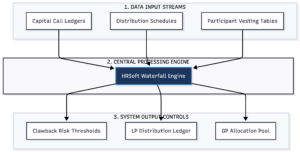
According to compliance documentation hosted by the Securities and Exchange Commission, regulatory scrutiny on private fund expenses and distribution allocations has reached record highs.
Deploying dedicated software minimizes these compliance vulnerabilities entirely. It guarantees that calculations remain identical to the explicit legal parameters defined in your LPA.
Furthermore, automating these operations frees up finance teams to focus on active wealth creation rather than manual data checking.
Securing the Future of Alternative Asset Compensation
As private equity continues to scale, firms that rely on manual infrastructure will struggle to match market speeds.
Attracting elite dealmakers requires offering modern, transparent incentive tools that track performance value reliably. By centralizing your distribution management, you protect your firm from compliance errors and optimize your talent strategy.
To explore how enterprise tracking platforms remove administrative friction and secure complex incentive programs, book a demo of on our variable compensation module.