


Long-term incentive design typically looks clean on paper: it vests over time, is tied to performance, and helps retain your best people.
In practice, the conversations that happen inside organizations and comp teams are messier, more political, and more interesting than any plan document.
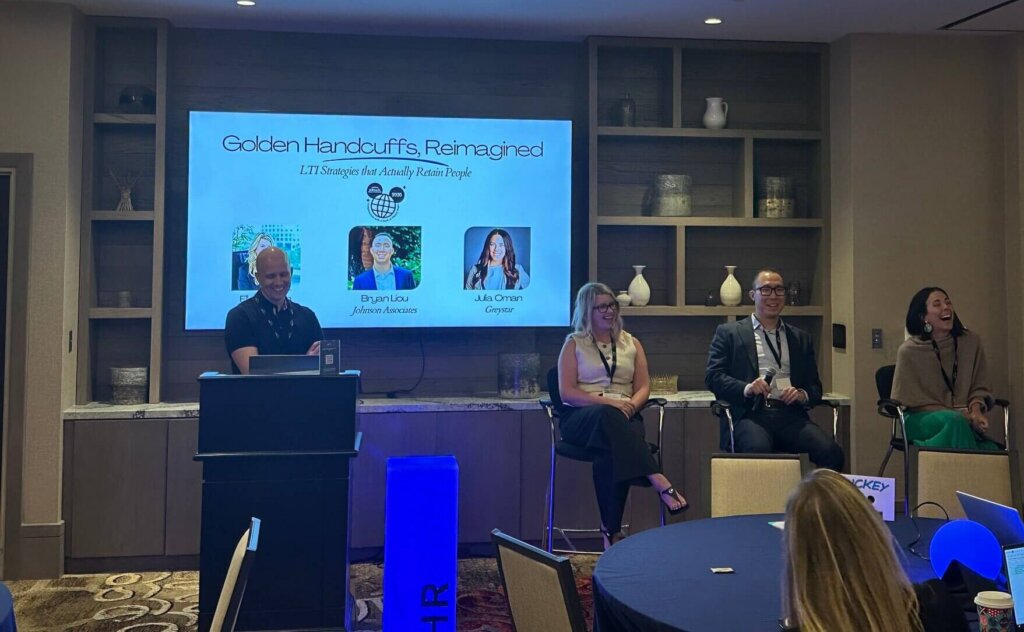
At HRSoft’s Motivations 2026 conference, we brought together three practitioners who live these tensions daily:
- Julia Oman, Senior Director – Global Equity Investments at Greystar, one of the largest real estate management companies in the world.
- Ellen Austin, Finance Manager, Americas Property at Sedgwick, a world-leading professional services firm for risk and claims administration.
- Bryan Liou, Managing Director at premier financial services advisory firm Johnson Associates.
With our three panelists sharing their insights, we held a frank, hour-long conversation about what effective LTI design actually looks like once theory meets application.
The One-Size-Fits-All LTI Plan Is Quietly Dying
The most consequential shift in LTI design right now is not about vesting schedules or eligibility thresholds, but who the plan is actually designed for.
One panelist put it directly: large diversified financial institutions are moving away from parent company plans, and toward specific business unit structures that mirror what standalone competitors in that niche actually offer.
“You’ll have banks with their traditional business, but they also run asset management, and within asset management they’ve got hedge fund strategies and private equity strategies. Now we’re seeing a lot more bespoke plans built for each subsidiary, aligned more closely with that subsidiary’s actual market.”
A private equity professional sitting inside a large bank no longer wants or expects a long term incentive program that mirrors that of its parent company. They want carry, investment linked returns, and real line of sight to the value they are creating.
Ms. Oman described the same dynamic at Greystar, where thousands of property management employees and a smaller investment and development team require fundamentally different approaches:
“Things have to look different for those groups. Property management and investment professionals aren’t going to value the same type of LTI the same way.”
Designing multiple plans by business unit is the right answer, and almost nobody does it well.
Long Vesting Works for Investors. It Does Not Always Work for Talent.
The panel’s sharpest exchange came around the longer vesting arrangements that were a standard for many years in private equity and real estate investment vehicles, and in some cases stretching out 8 to 10 years.
The mechanics make sense from an investor perspective. LPs commit capital for a decade, and want to know the team is committed too. But that same structure creates real friction on the talent side, particularly for recruiting senior professionals mid-career and for retaining people whose personal financial horizon does not align with the fund’s. And Ms. Austin notes that a plan is only as good as an employee’s understanding of it, and that education around compensation packages must be organizational:
“Education from the top-down is very, very important.”
A candid admission from the panelists was that long vesting fails to move talent in either direction; at least as reliably as plan designers assume. It neither attracts people who don’t believe they’ll see the realization, nor retains people who have already decided to leave and are willing to walk away from unvested carry.
The response from the panelists, and the market in general, is a layered approach. Running a separate long-term incentive vehicle with a shorter timeframe than carry alongside the longer vehicle gives participants something tangible and near-term while keeping the fund-aligned structure intact for senior investment professionals. It’s not a perfect solution, but it reflects a growing acknowledgment that a single long dated instrument cannot do all the retention work on its own.
The takeaway is that vesting design needs to account for where people are in their careers, not just where the fund is in its life.
Retention Only Becomes a Priority After Someone Walks Out the Door
One panelist shared a cautionary pattern that will be familiar to anyone who has tried to get ahead of a talent problem before it shows up in exit data.
For years, their organization’s leadership resisted proactive LTI investment. The honest answer when pushed was simple: no one was leaving. That changed in the last 18 months, when competitors began actively poaching senior team members because the vesting mechanisms in place were not strong enough to hold them.
“We’ve been very reactive. Spending a lot of time combing through our programs to make sure they’re actually connected to our talent philosophy.”
What made the poaching more effective was not just competitive base pay. Competitors were buying people out of their unvested carry and LTI entirely, making them whole on what they were leaving behind and removing the one mechanism that was supposed to keep them. In a tight talent market, a well structured replacement deal effectively neutralizes years of retention planning in a single conversation.
Mr. Liou was direct about how common this has become in financial services: no competitor is shy about poaching talent, and the most aggressive firms treat unvested LTI as a negotiating variable rather than a barrier. The retention mechanism only works if the gap between what someone is leaving and what they are being offered is wide enough to matter.
The broader lesson is that LTI investment that gets deferred, because attrition is not yet visible, tends to become emergency spending once it is.
By then, the cost of replacing senior talent, including buying out their existing programs, almost always exceeds what proactive retention design would have cost. The firms that treat retention as a leading indicator rather than a lagging one consistently spend less and lose fewer people.
Employee Choice in LTI Sounds Good. It Rarely Is.
During the panel, a particularly striking insight emerged regarding employee-driven choice: allowing team members to decide what portion of their compensation is directed into equity or deferral initiatives. While the speakers acknowledged the value of offering limited flexibility, they cautioned that providing unrestricted options can be problematic.
“As a general rule, we tend to advise against allowing broad employee choice, or at least limiting it significantly. Standing up a program like that is a real operational challenge to begin with, and once it exists, you might only get 10 to 20% of people actually using it, and now you’re administering a whole program for a small slice of your population.”
The exception is private equity and asset management, where co-investment matching and direct fund access are compelling enough to drive meaningful participation. Even there, panelists noted that some firms have tried matching programs and pulled them back when uptake did not justify the overhead.
Employee choice is not a reliable lever. It depends almost entirely on whether the upside on offer is tangible enough to change behavior.
When it works, it works decisively. One panelist described a bonus deferral plan open to a broad group of eligible employees who can elect to roll a portion of their annual bonus into phantom equity in the company. The plan has been so successful they are running out of shares to issue, driven not by dividend yield but by valuation appreciation. Participants can see the number move in real terms, which fundamentally changes how they engage with the program.
“Letting a participant log in in real time and see numbers tied directly to their own work has been the single most valuable thing we’ve done.”
The contrast between the two examples is instructive. A choice program with low perceived upside produces low participation and high administrative burden. A choice program with real, visible, trackable upside produces the opposite. The design question is not whether to offer choice, it is whether the underlying instrument is compelling enough to earn it.
That line landed as both an observation and a design principle: visibility is not a feature. It is the mechanism through which LTI programs actually retain people.
“I Think Change is Coming.”
The final question invited each panelist to be a little controversial about what they expect to change in LTI design going forward.
Mr. Liou did not hesitate:
“We’ve told clients for years that specialized, business unit specific plans are a real competitive advantage. But surprisingly few firms actually do it, or do it well, and I don’t expect that to change much going forward.”
Ms. Oman’s answer was more hopeful, if equally measured, distinguishing between what she expects and what she hopes for, and landing on quiet optimism: more sophisticated practitioners, better proposals to senior leadership, incremental but real movement.
“I don’t expect a dramatic shift. But I think change is coming.”
LTI design is full of known, articulable answers that organizations consistently fail to act on. The gap between knowing and doing is where most compensation programs stall.
The firms that move first tend to move because something forced their hand. The better outcome is moving before it does.
HRSoft builds the infrastructure that makes complex LTI and carry programs administrable at scale, from participant portals and real time visibility to audit trails and document governance. If your current approach relies on spreadsheets, manual distribution tracking, or disconnected systems, book a demo to see what a purpose built platform looks like.